Māui Card Game
Māui Original IP
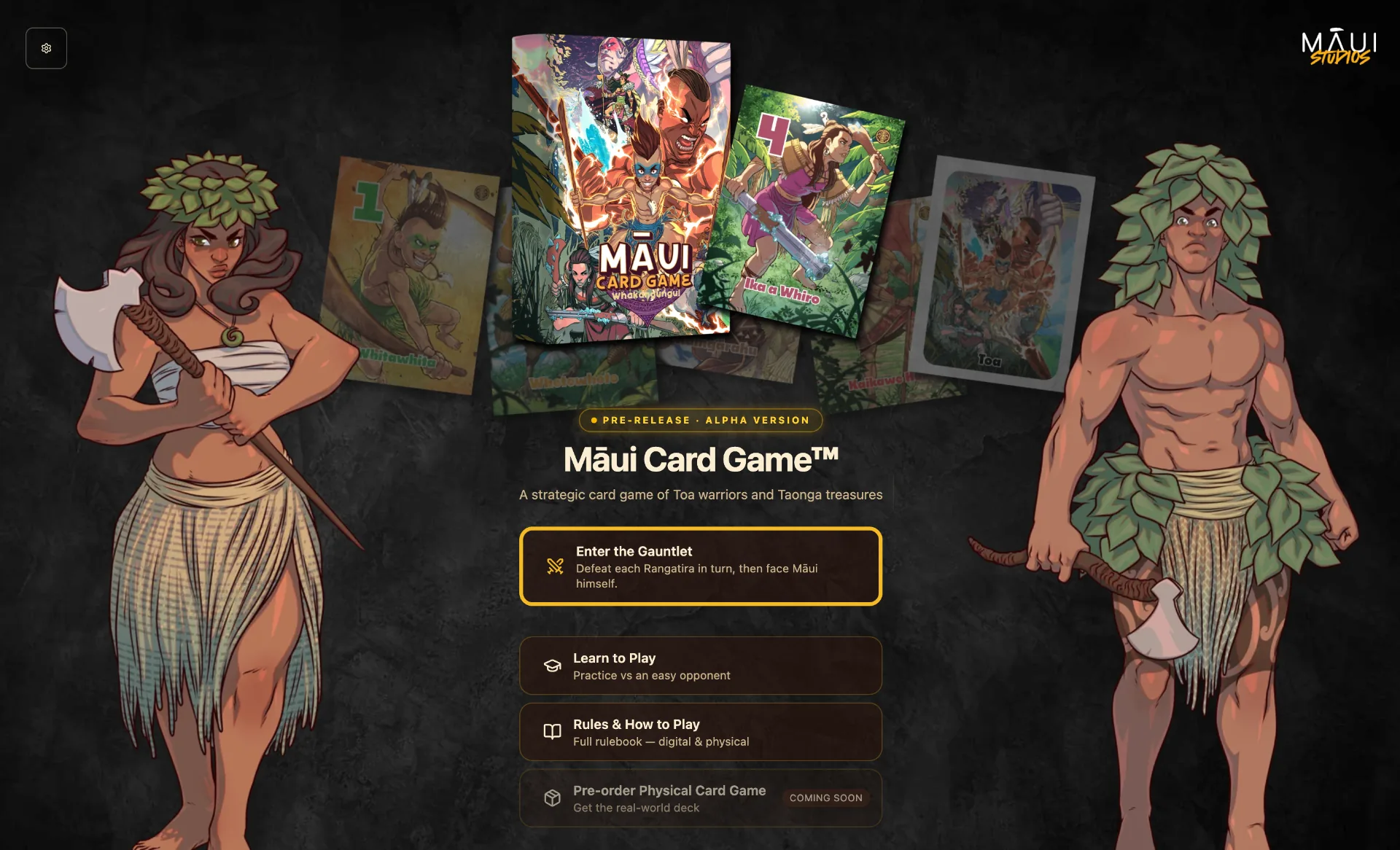
A single-player digital strategy card game grounded in Māori mythology - pitting the player against AI opponents in a tactical battle of Toa warriors and Taonga treasures, with formations, avatar perks, and a distinctive War / Whawhai battle system.
Role
Deliverables
- 60-card deck with 6 colours × 10 Ihi values, each a unique Toa warrior
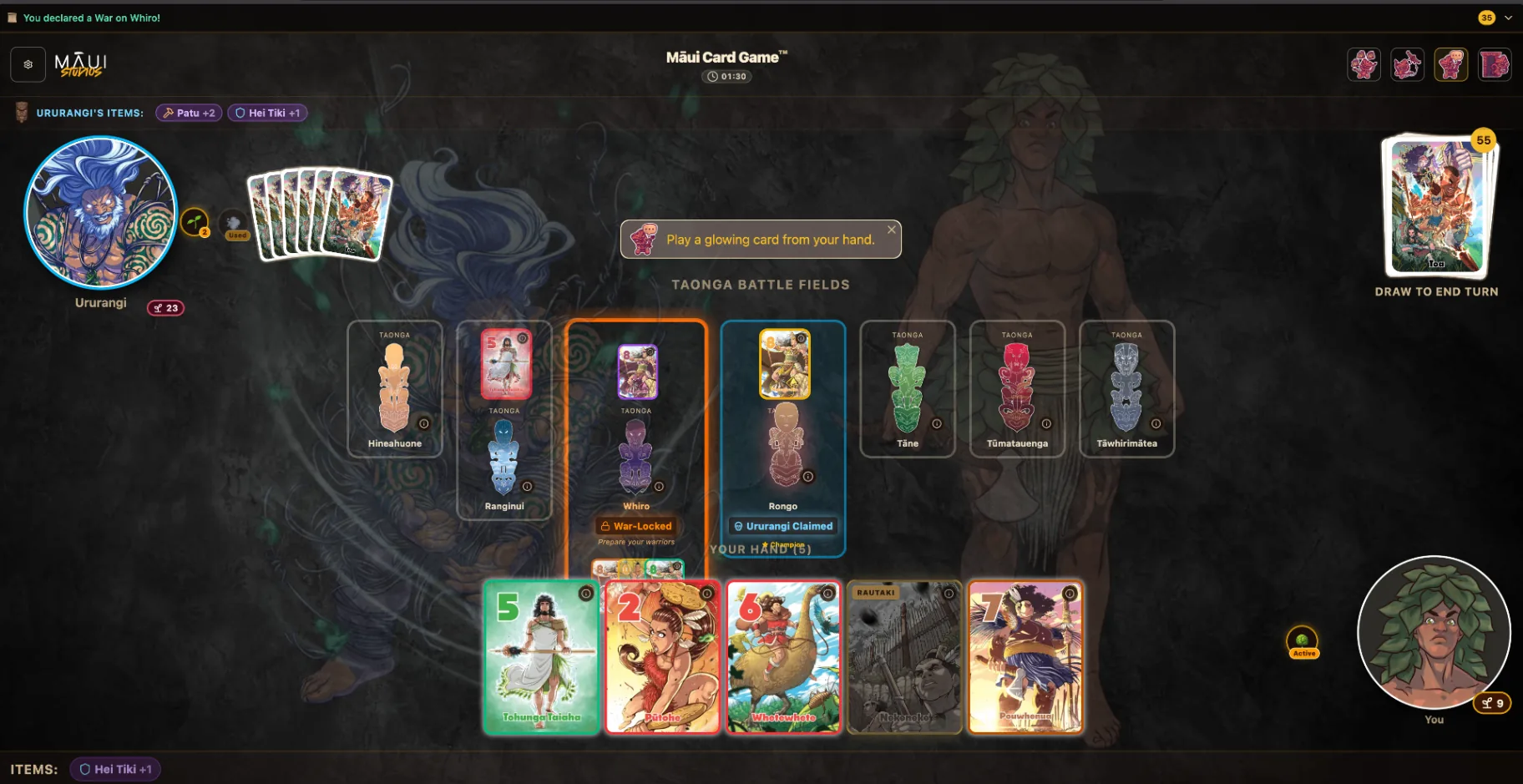
- 7-row Taonga board with formation-based claiming
- War / Whawhai turn-based battle system with boost tokens
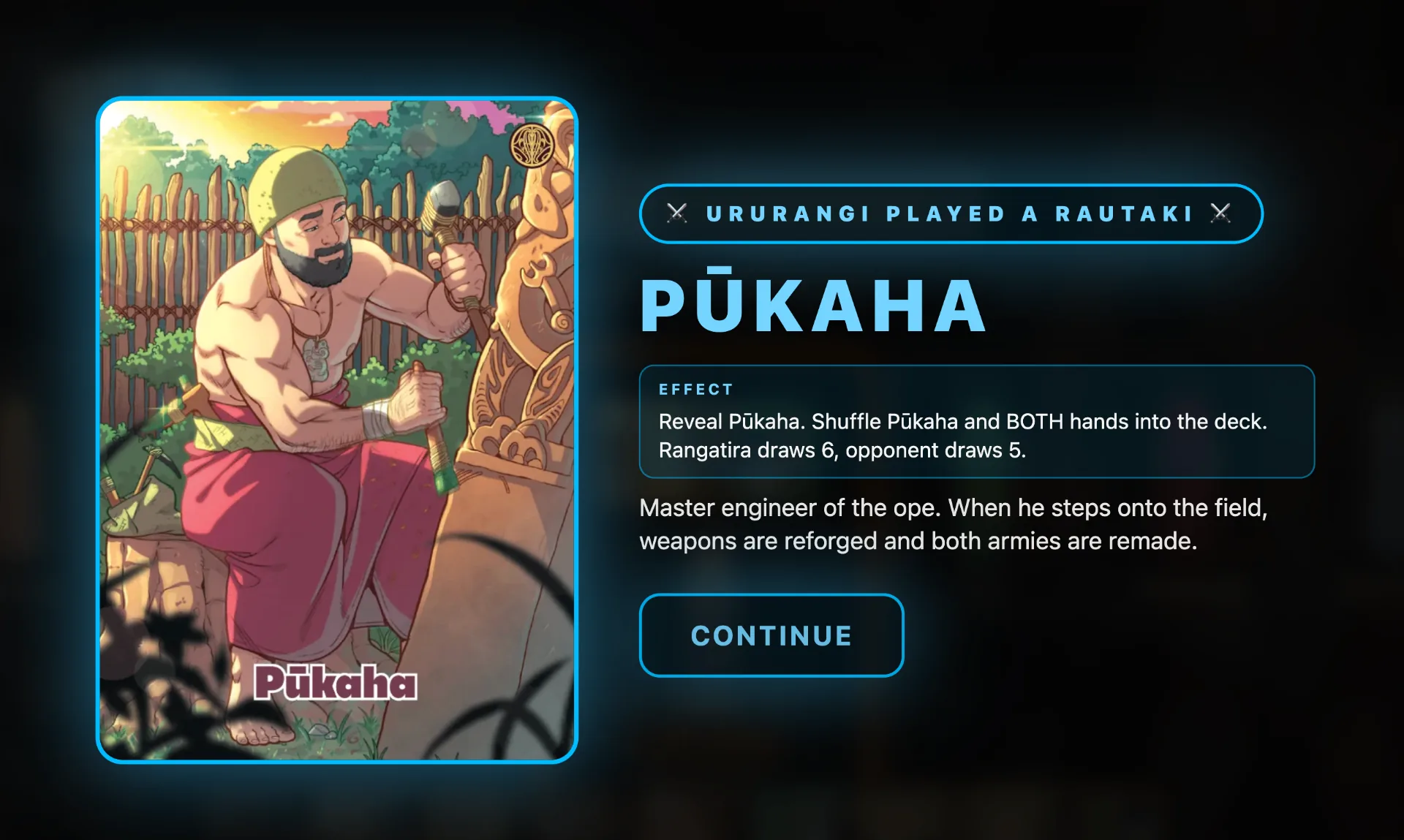
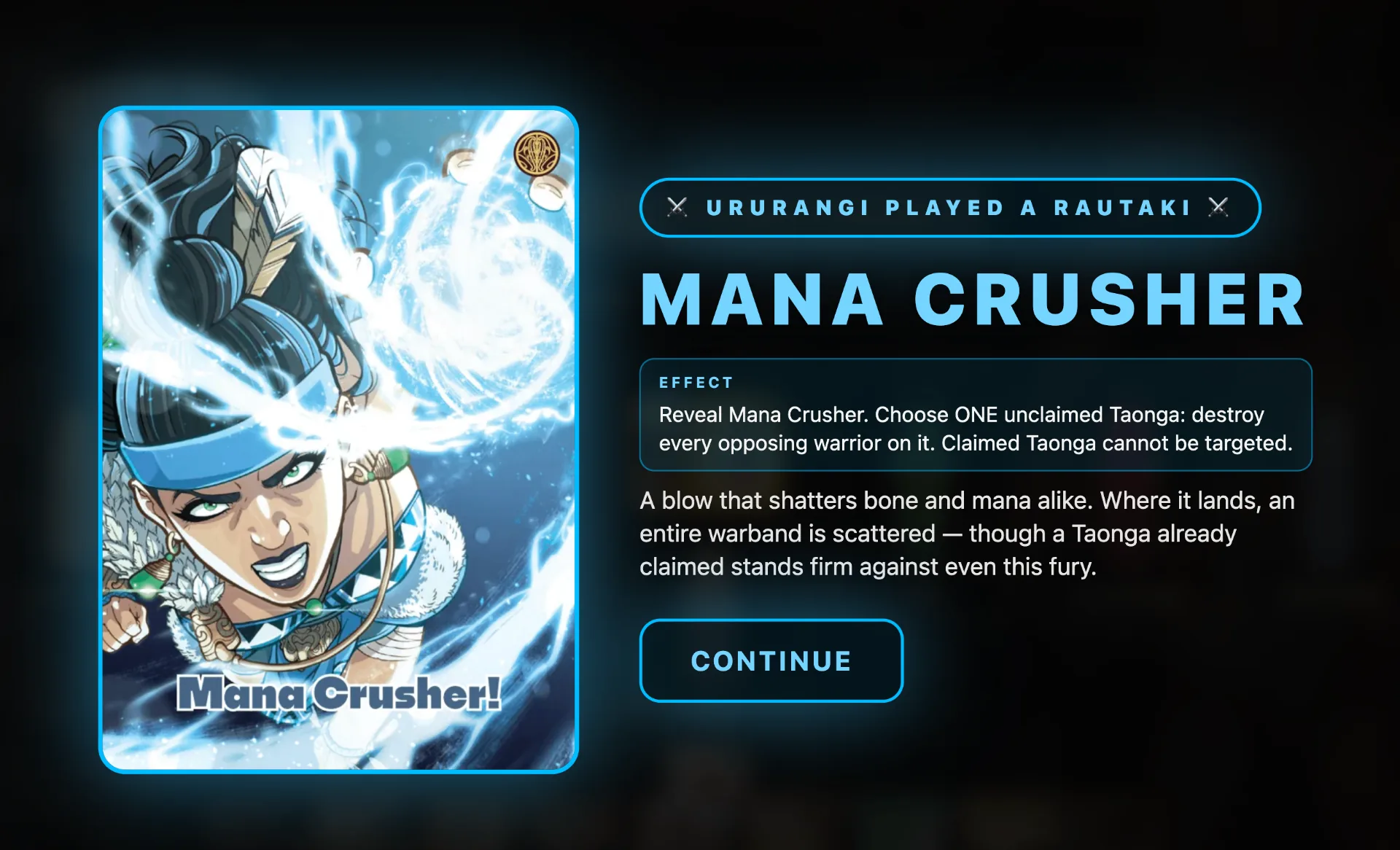
- 13 Rautaki strategy cards (Pūkaha, Taniwha, Wā Kai, Nekeneke)
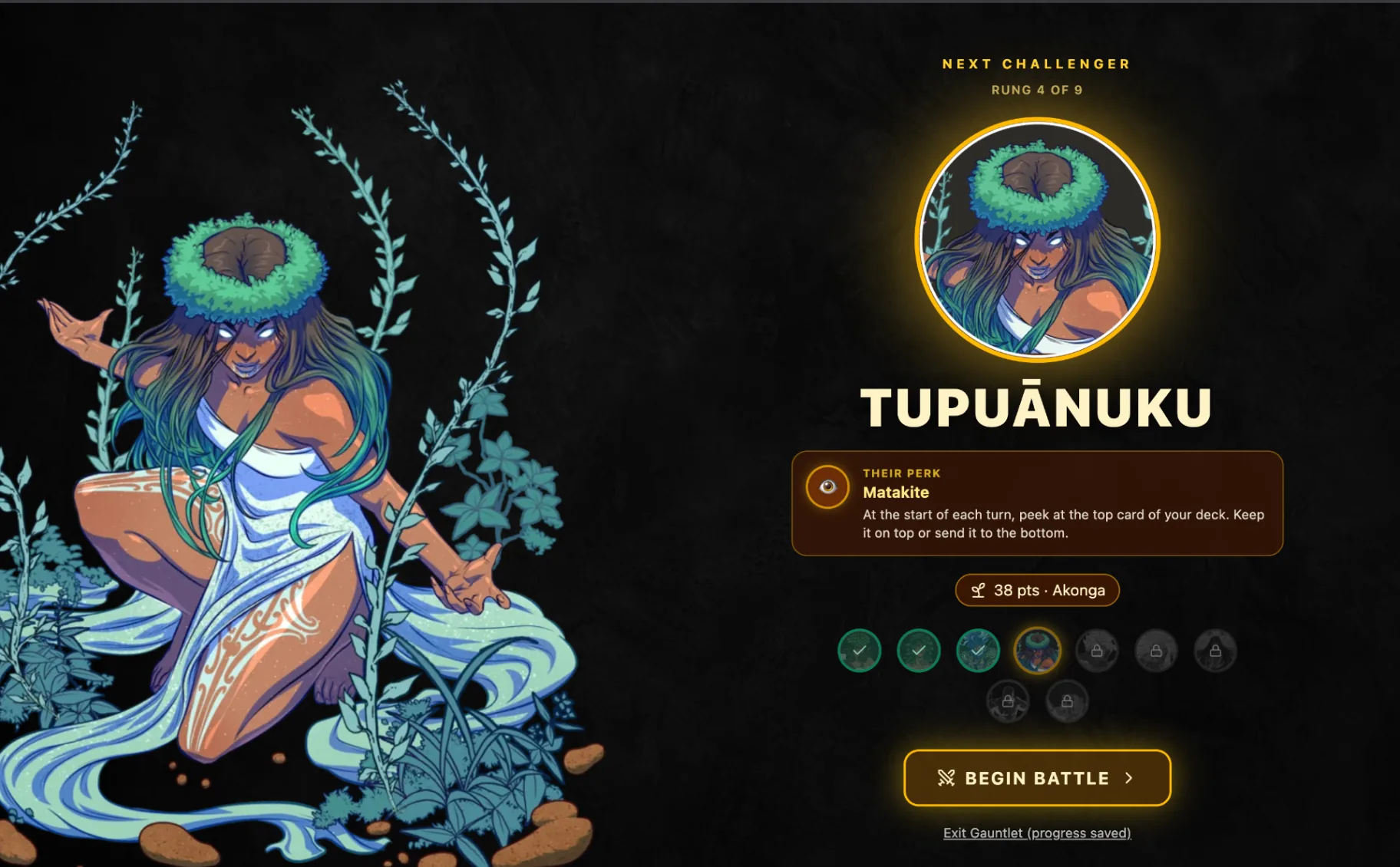
- Eight atua-aligned avatars with runtime perks, plus Māui boss and New Game + final boss
- Gauntlet mode and built-in Learn to Play tutorial
- React 19 + TanStack Start edge-deployed web build with i18n architecture for te reo Māori
Outcome
A polished single-player strategy card game that holds cultural depth and tactical richness in one product - establishing a distinctive original IP for Māui Studios that fuses Māori mythology with contemporary strategy gaming through self-determined cultural expression.
Project Overview
Māui Card Game is a single-player digital card game that pits the player against AI opponents in a strategic battle of warriors (Toa) and treasures (Taonga). Inspired by Māori mythology and built around a dark, atmospheric theme, it blends accessible turn-based card play with deep tactical layers - formations, avatar perks, and a distinctive War / Whawhai battle system.
The game reimagines Māori mythological figures as playable avatars and adversaries. Players choose from eight atua-aligned warriors - Hine, Tāne, Ururangi, Tupuānuku, Tonga, Tūāraki, Ahi Riri, and Manuāwhā - each with a signature, lore-backed perk that shapes how they play. The ultimate challenge is defeating Māui himself, followed by a New Game + run against a mysterious final boss.
The central design challenge was to make Māori mythology the design language of the game rather than a reskin - grounding every card, avatar, and ability in lore while still delivering a genuinely accessible and strategically deep experience. This reflects a wider principle in Indigenous game design: that games become self-determined cultural spaces when culture is carried in the mechanics themselves rather than layered on as theme (LaPensée, 2017). It meant balancing approachability (turn-based play and an in-game tutorial) against tactical depth (formations, runtime perks, the Whawhai battle, and strategy cards), and building the experience on a localisation-ready architecture.
SOW Snapshot
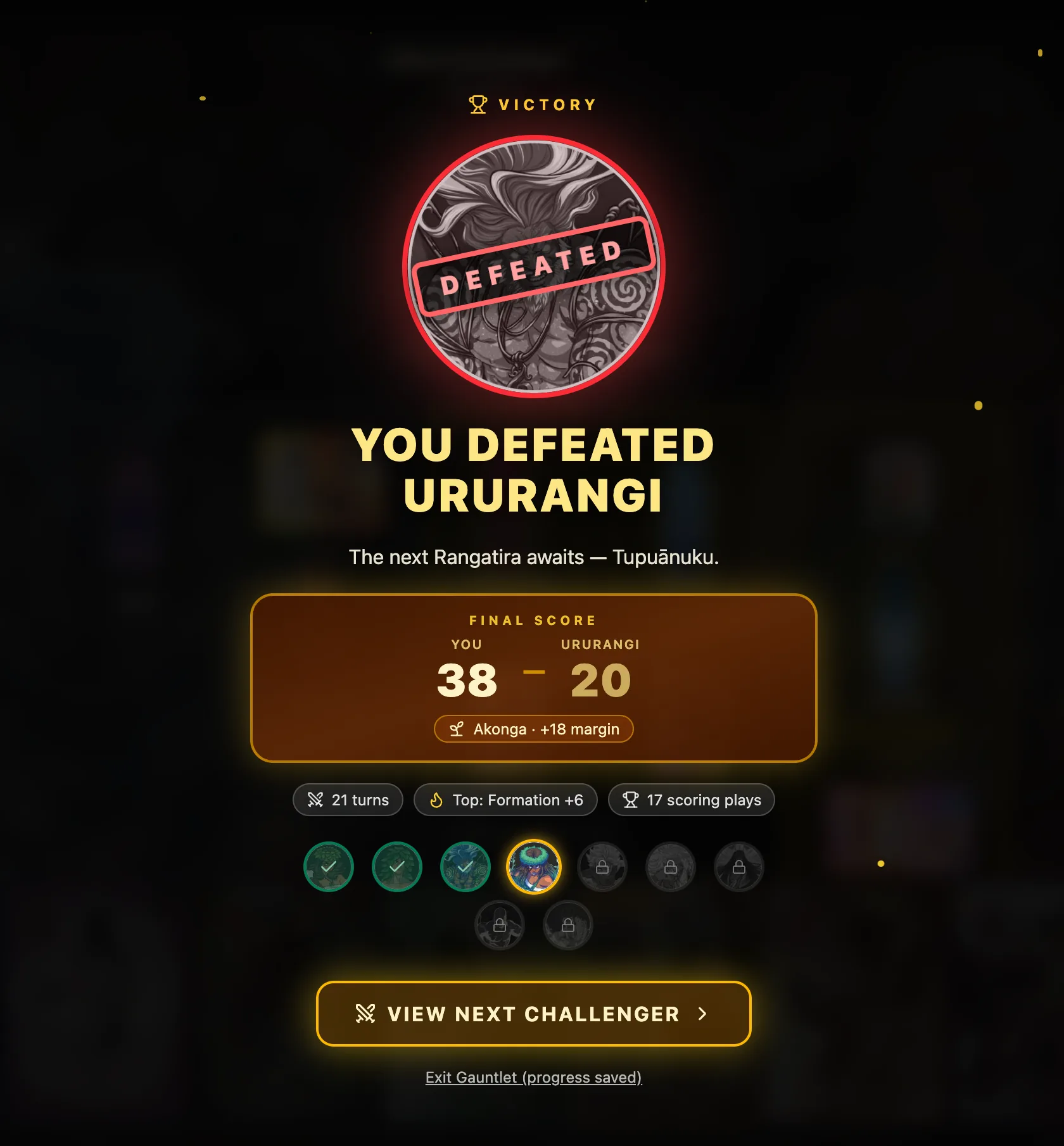
- Core System: A 60-card deck (6 colours × 10 Ihi values, each card a unique Toa warrior with a rank and title); 7 Taonga rows claimed by building valid formations (consecutive colours, of-a-kind, successive Ihi); a War / Whawhai turn-based battle triggered when a row is contested (boosted Ihi values, sacrifice tactics, token-based abilities); 13 Rautaki strategy cards (e.g. Pūkaha, Taniwha, Wā Kai, Nekeneke) for combos and disruption; an append-only scoring ledger feeding a detailed victory recap
- Avatars: Eight atua-aligned warriors, each with a runtime perk state; a Māui boss fight and an unlockable New Game + final boss
- Game Modes: Gauntlet - a ladder of eight escalating AI opponents culminating in the Māui boss and New Game +; Learn to Play - a guided tutorial with contextual hints that onboards players without a separate rulebook
- Technical: Built on React 19 with TanStack Start (edge-deployed); a context-aware real-time audio system (home, boss, victory themes); an internationalisation (i18n) architecture ready for te reo Māori localisation, with placeholder text currently in place; crash reporting and anonymous, rate-limited feedback via serverless functions
- Audience: Solo strategy card-game fans seeking cultural depth; players who enjoy Slay the Spire-style gauntlet progression but prefer head-to-head card placement over deckbuilding; anyone interested in Māori mythology presented through interactive play
- Service Connection: Game Design, Interactive Development, Websites and Apps, Visual Design, IP Creation and Story Development, Cultural storytelling
Outcomes
The game's defining quality is that te ao Māori is its design language, not its decoration. Every card, avatar, and ability is grounded in lore, and the perk system gives each avatar a runtime state that changes fundamental rules - Tāne draws deeper hands, Ururangi cycles the wind, Manuāwhā steals enemy warriors - so the mythology directly shapes how the game plays - consistent with research showing that games become sovereign, self-determined cultural spaces when Indigenous values and stories are embedded in their mechanics, not only their visuals (LaPensée et al., 2022). The Rautaki strategy cards are not simple spells but multi-step decision trees involving targeting, repositioning, truce timers, and clone summoning, while the Whawhai system turns a single contested row into a self-contained mini-game with its own visual timeline and boost-token economy.
The result is a polished single-player strategy card game that holds cultural depth and tactical richness in one product - approachable through its built-in tutorial yet deep through formations, perks, Rautaki, and Whawhai, and built on a localisation-ready architecture. As a self-contained, edge-deployed web experience, it establishes a distinctive original IP for Māui Studios that fuses Māori mythology with contemporary strategy gaming through self-determined cultural expression (LaPensée, 2021).
Impact Metrics
Intended Outcomes
- Present Māori mythology through genuinely engaging interactive play, as a design language rather than decoration
- Deliver an accessible yet tactically deep solo card-game experience
- Make te ao Māori central to a contemporary digital game format, with the architecture ready for full te reo Māori localisation
- Establish a distinctive original IP for Māui Studios beyond client commissions
Broader Impact
- Demonstrates te ao Māori as a foundation for original interactive IP - every system grounded in lore rather than reskinned - strengthening Māui Studios' capability to create and own its own properties
- Models the kind of self-determined cultural game that scholarship identifies as the most authentic and powerful - Indigenous stories told on their own terms, with meaning carried through the mechanics rather than surface aesthetics (LaPensée, 2017; LaPensée et al., 2022)
- Positions Māui Studios within the global solo strategy card-game space with a culturally distinctive offering
Future Opportunities
- A physical hybrid edition extending the digital game into tabletop play
- A crowdfunding campaign to fund a premium physical release
- An expanded avatar roster, additional game modes, and new Rautaki cards
- Head-to-head and multiplayer modes
- Educational and te reo Māori-forward versions for kura and learning contexts
- Companion lore content developing the mythological world into a broader IP
References
- LaPensée, E. (2017). Self-determination in indigenous games. In J. Sayers (Ed.), The Routledge companion to media studies and digital humanities (pp. 128–137). Routledge.
- LaPensée, E. (2021). When rivers were trails: Cultural expression in an indigenous video game. International Journal of Heritage Studies, 27(3), 281–295. https://www.tandfonline.com/doi/full/10.1080/13527258.2020.1746920
- LaPensée, E. A., Laiti, O., & Longboat, M. (2022). Towards sovereign games. Games and Culture, 17(3), 328–343. https://doi.org/10.1177/15554120211029195