Quantum Comix
Te Whai Ao - Dodd-Walls Centre / Tūhura Otago Museum
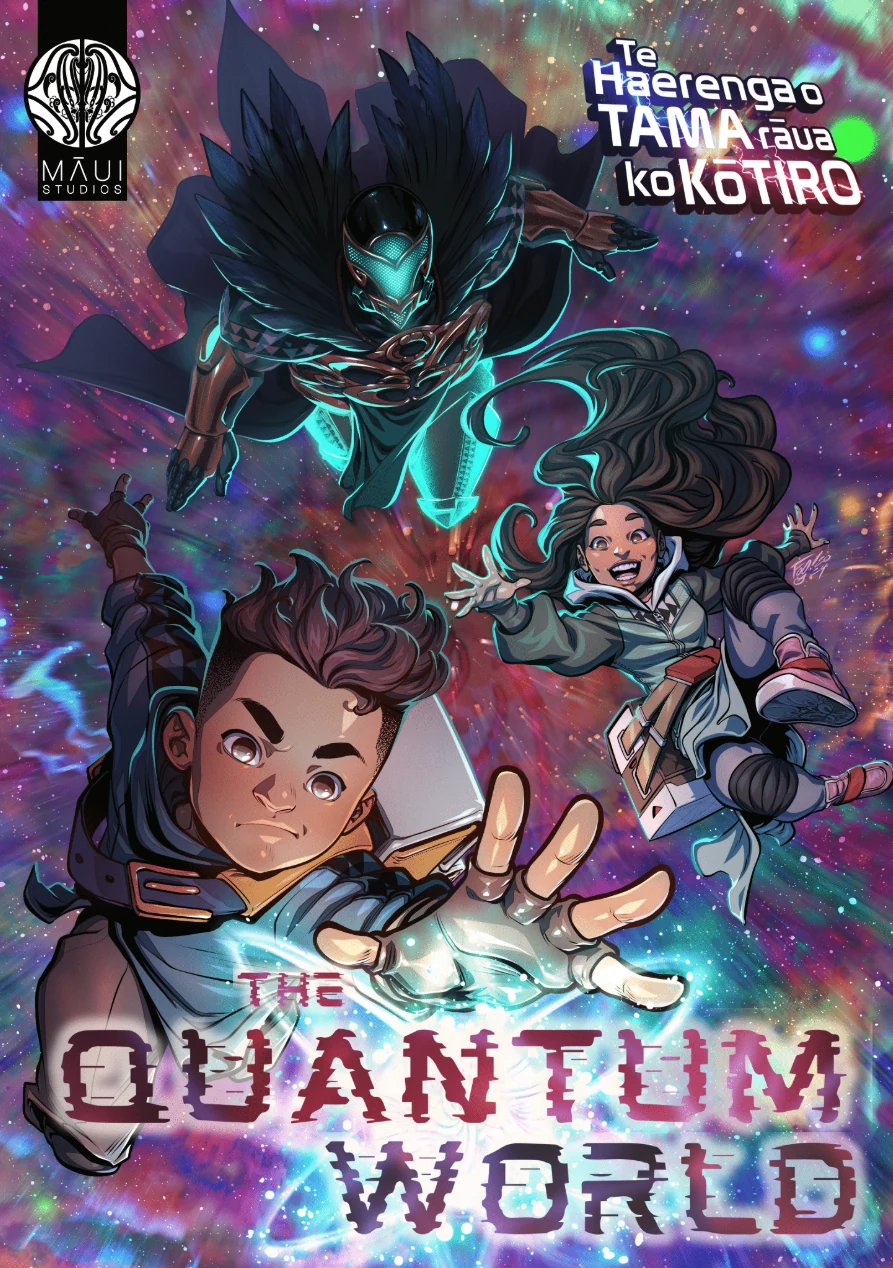
A character-driven illustrated Comic Book making quantum physics accessible to rangatahi - developed with Te Whai Ao - Dodd-Walls Centre and Tūhura Otago Museum for school and museum distribution.
Role
Deliverables
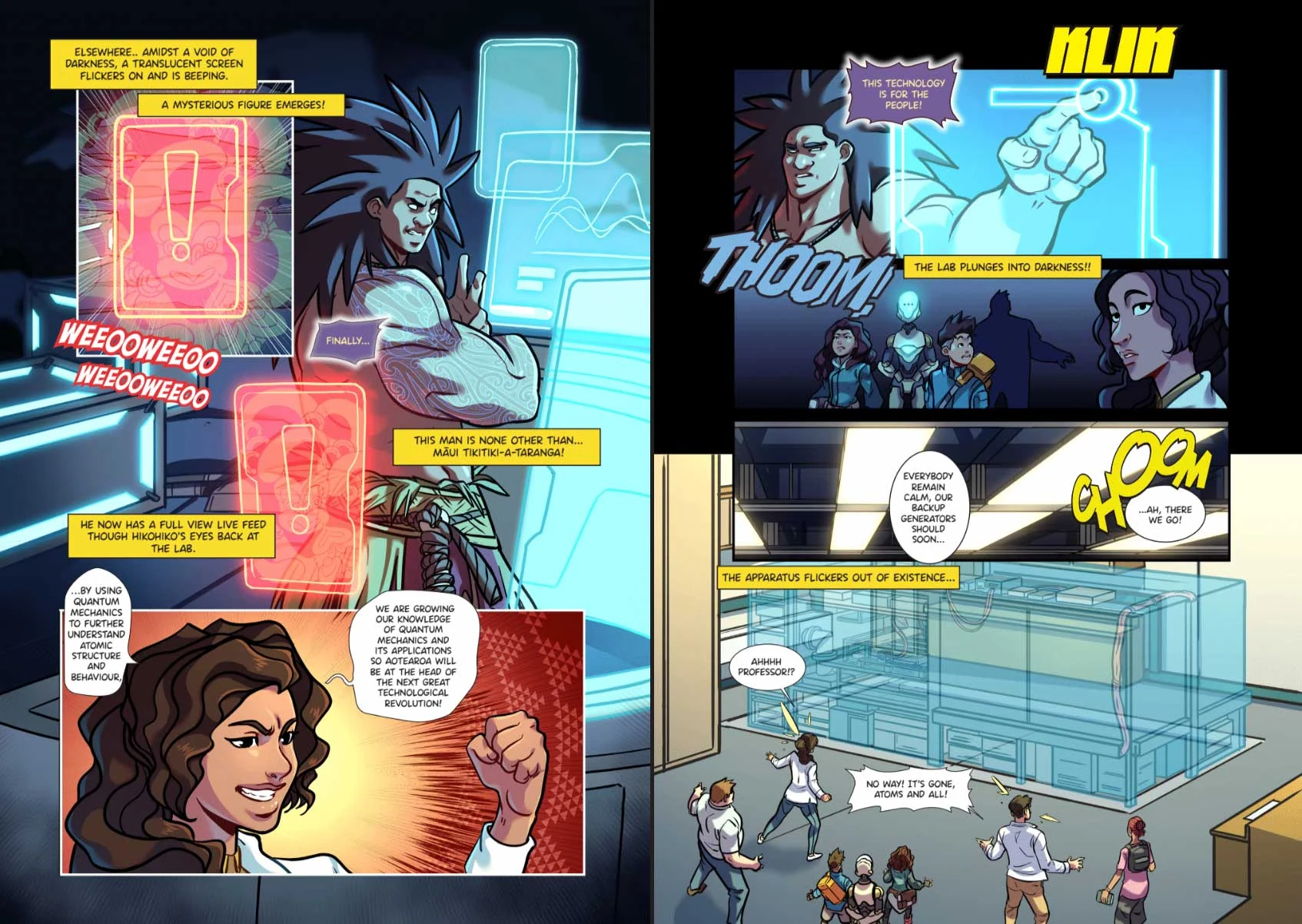
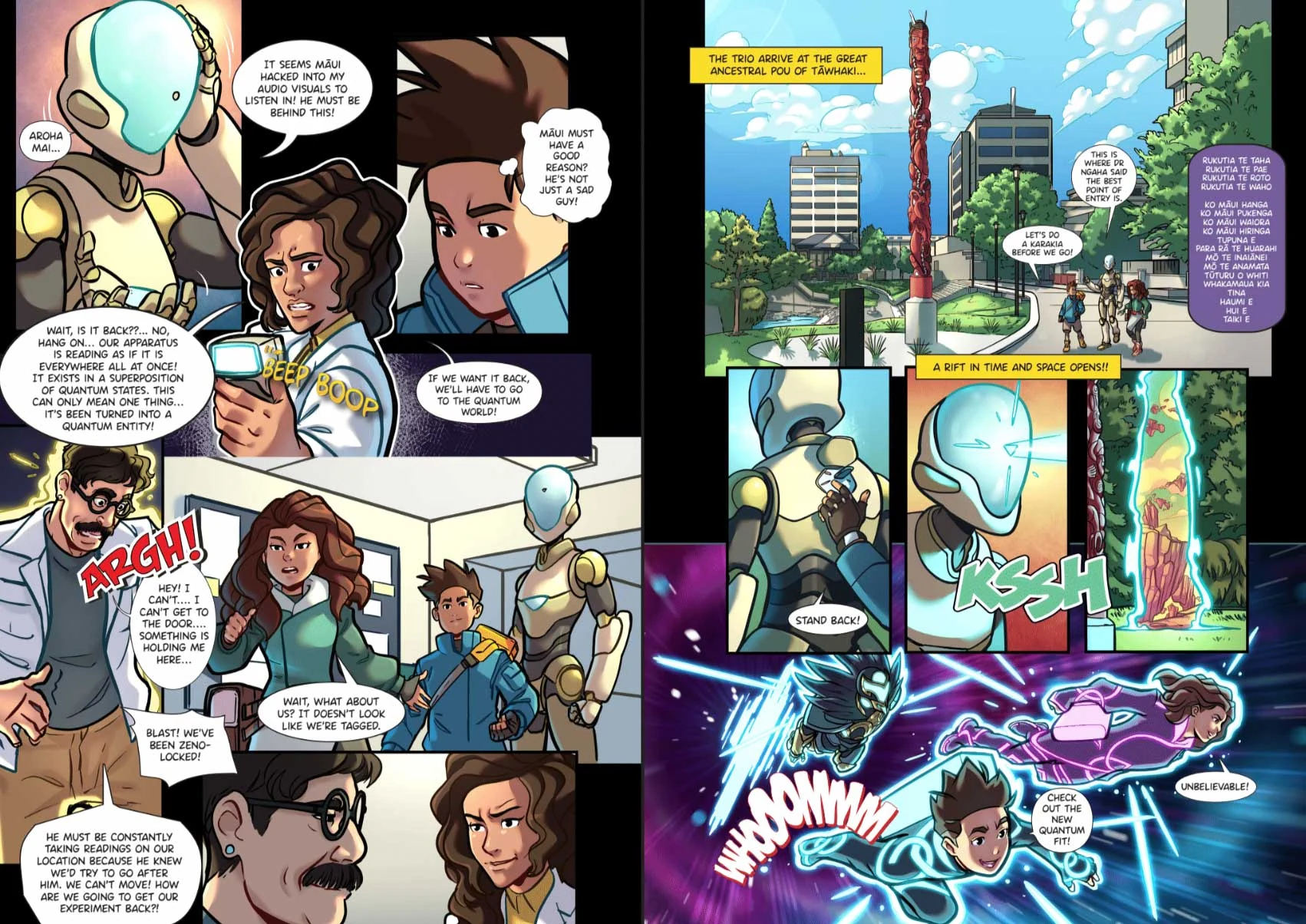
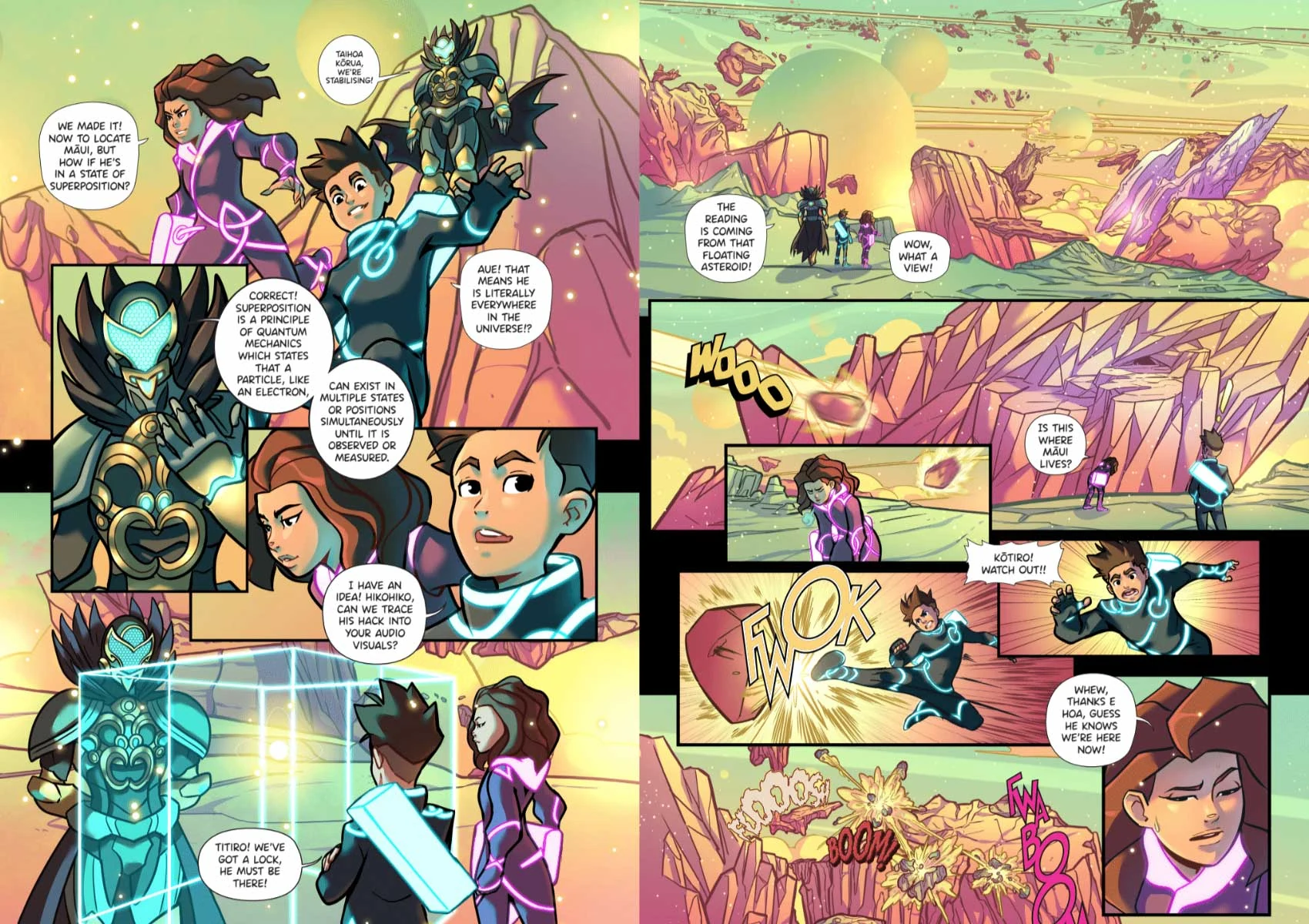
- Illustrated Comic Book - script, character and world design, full illustration, page layout
- Print-ready files and digital version
- Scientifically reviewed narrative co-developed with Te Whai Ao researchers
- Public-facing asset for school and museum deployment
Outcome
A complete, scientifically reviewed illustrated Comic Book - giving Te Whai Ao and Tūhura Otago Museum a high-quality public-facing science communication asset, and modelling Comic Books as a legitimate format for frontier-research engagement.
Project Overview
Quantum Comix was developed in partnership with Te Whai Ao - Dodd-Walls Centre for Photonic and Quantum Technologies and Tūhura Otago Museum to make quantum physics and quantum technology accessible to rangatahi. Quantum science sits at the frontier of international research, yet remains one of the least understood fields among general audiences - including the young people who may one day work within it.
The project responded to a genuine gap: the need for high-quality science communication that could reach rangatahi through schools, museums, and public engagement without requiring prior scientific knowledge - building the kind of broad science literacy widely recognised as a public good (National Academy of Sciences, 2016). Māui Studios used the Comic Book format to carry the science through character, narrative, and visual storytelling in ways that abstract diagrams and lectures cannot replicate.
The central challenge was that quantum concepts are genuinely counterintuitive. Superposition, entanglement, and wave-particle duality cannot be explained through everyday analogy without distortion, nor through pure abstraction without losing a general audience - so the work had to find a middle path that made quantum behaviour feel real and compelling without misrepresenting the science. A second challenge was relevance: rangatahi need to see a reason to care before engaging with unfamiliar technical content, so the project needed to make the why land before the what. A third was institutional: Te Whai Ao is a Centre of Research Excellence, and the creative work needed to earn the confidence of researchers as well as the engagement of museum visitors and students.
SOW Snapshot
- Core Deliverables: Illustrated Comic Book, print-ready files, digital version
- Audience: Rangatahi - secondary school age and museum visitors
- Format: Comic Book - script development, character and world design, full illustration, page layout, publishing
- Key Requirements: Scientific accuracy (reviewed by Te Whai Ao researchers), age-appropriate narrative, accessibility to non-specialist readers, museum and school deployment
- Partner Institutions: Te Whai Ao - Dodd-Walls Centre (scientific content and research partnership), Tūhura Otago Museum (public engagement and distribution)
- Service Connection: Comic Books, Science communication, Visual Design, Publishing, Strategic Communication
Outcomes
Māui Studios developed a character-driven Comic Book narrative in which rangatahi characters encounter and interact with quantum phenomena in ways that make the science feel observable, consequential, and tied to real choices - so reading the comic was an act of science communication rather than a disguised worksheet. The visual system gave quantum behaviour a distinct aesthetic language - a visual grammar for the invisible - providing consistent, carefully designed representations for phenomena that have no everyday visual equivalent, supporting comprehension without fabricating misleading analogies.
Scientific content was developed in close collaboration with Te Whai Ao researchers throughout, keeping the narrative grounded in the actual science while the creative team shaped it into a form rangatahi could access without prior knowledge. Tūhura Otago Museum's involvement provided a structured public-engagement and deployment pathway from the outset.
Māui Studios delivered a complete, scientifically reviewed illustrated Comic Book for publication and distribution across school and museum contexts - giving both partners a high-quality public-facing asset, and strengthening the studio's position at the intersection of research rigour, creative storytelling, and accessibility.
Impact Metrics
Intended Outcomes
- Increase rangatahi curiosity and engagement with quantum science and technology
- Make quantum concepts accessible to secondary school audiences without prior scientific knowledge
- Provide Te Whai Ao with a public-facing communication tool that reflects the quality of its research
- Support Tūhura Otago Museum's public science education mandate
Broader Impact
- Demonstrates that Aotearoa's most advanced science institutions can use creative storytelling to close the gap between frontier research and public understanding
- Builds a model for Comic Books as a legitimate science communication format in institutional contexts, with implications for how research centres and museums approach public engagement
Distribution and usage data are held by Te Whai Ao - Dodd-Walls Centre and Tūhura Otago Museum.
Future Opportunities
- Sequel volume covering photonics, superconductivity, or quantum computing (Te Haerenga Vol III: Wrath of Quench is a connected project)
- AR integration - AR triggers on printed pages linking to animations of quantum phenomena
- Exhibition adaptation - illustrated panels or interactive displays for Tūhura or other museum venues
- Curriculum alignment and teacher notes for formal science classroom use
- Science communication model licensing or adaptation for other research institutions
References
- Dodd-Walls Centre for Photonic and Quantum Technologies. (2024). Research and public engagement. https://www.dodd-walls.ac.nz
- Tūhura Otago Museum. (2024). Education and public programmes. https://www.otagomuseum.nz/learning
- National Academy of Sciences. (2016). Science literacy: Concepts, contexts, and consequences. National Academies Press. https://doi.org/10.17226/23595