Wrath of Quench Pt I
Te Whai Ao - Dodd-Walls Centre / Tūhura Otago Museum
A science-communication graphic novel translating superconductivity, photonics, and quantum science into an accessible illustrated narrative for rangatahi and public audiences - produced with Te Whai Ao - Dodd-Walls Centre and Tūhura Otago Museum.
Role
Deliverables
- Completed graphic novel publication
- Print-ready PDF files
- Digital distribution version
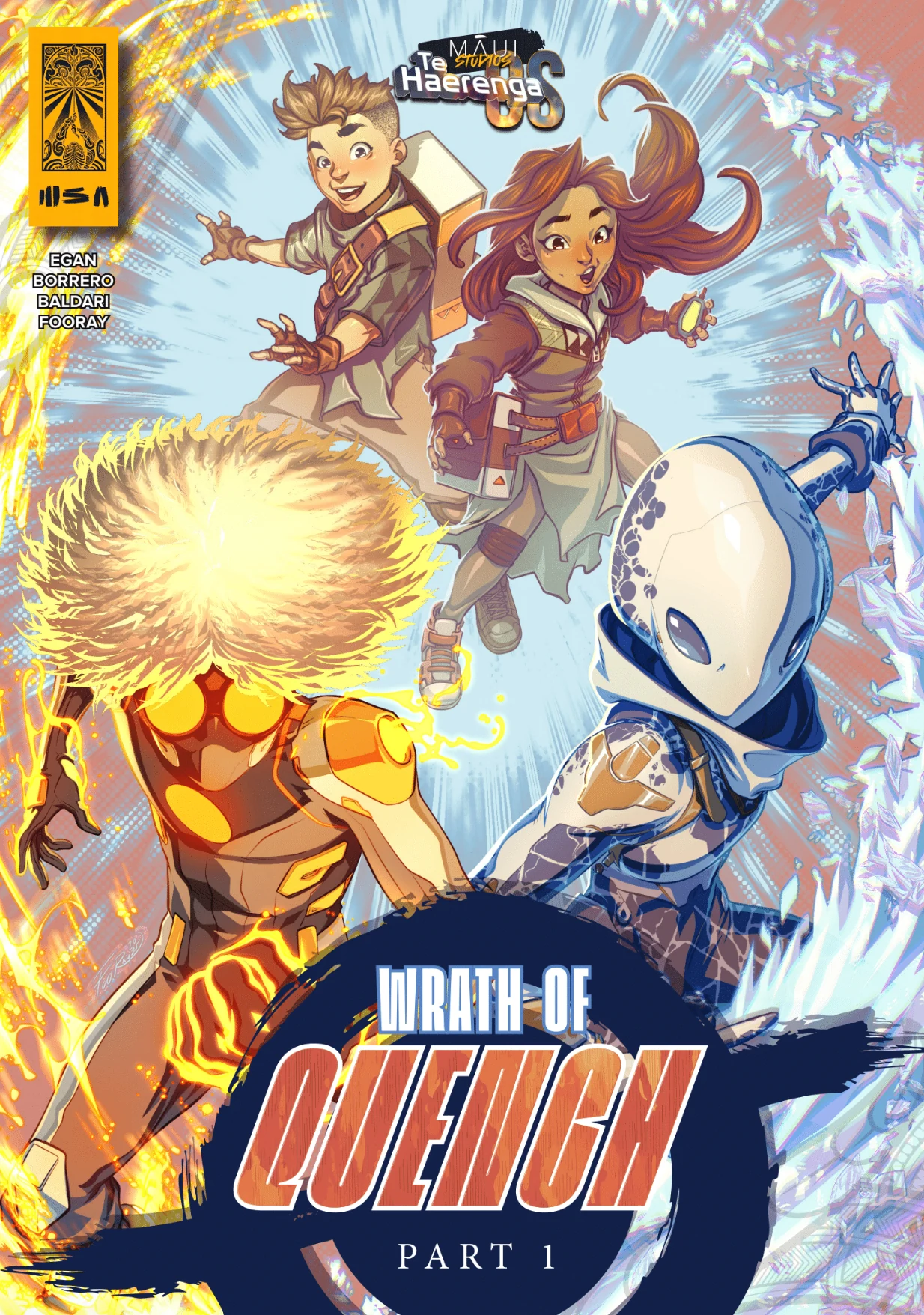
- Cover artwork
- Selected promotional visuals
Outcome
A narrative-led science translation delivered as a fully illustrated print and digital publication - landing during the UN International Year of Quantum Science and Technology and aligned with Te Whai Ao's outreach mission across schools, museums, and public audiences.
Project Overview
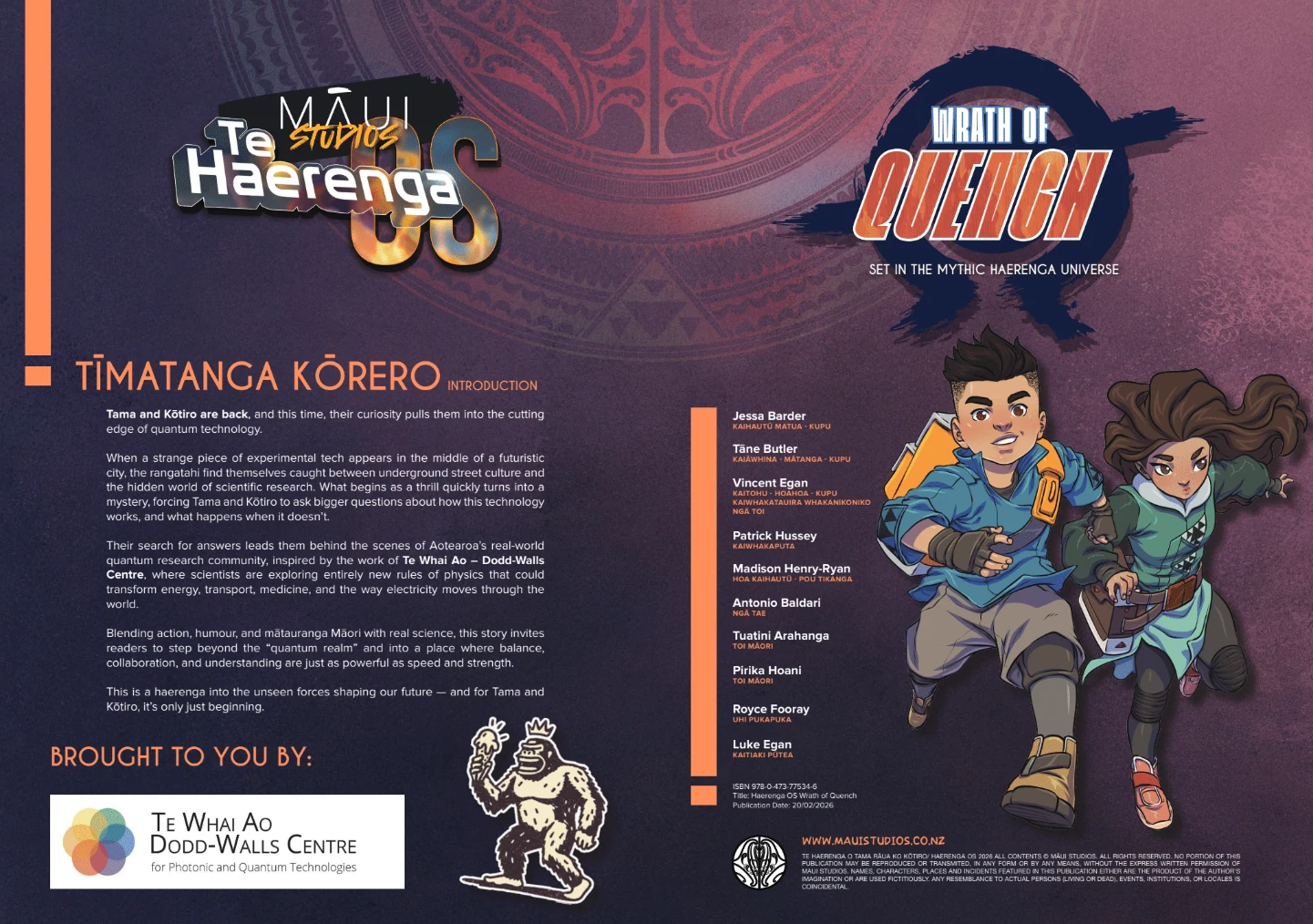
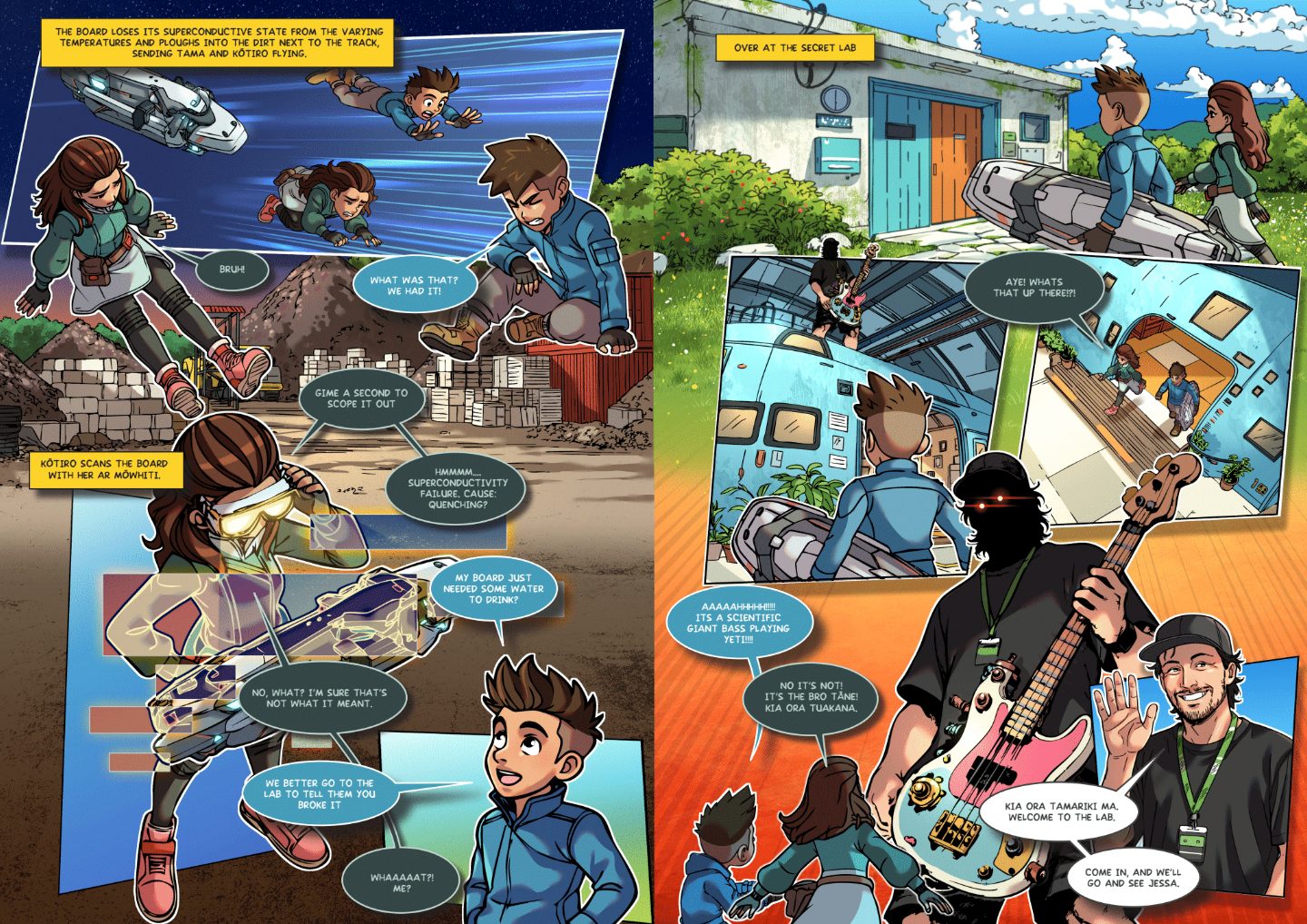
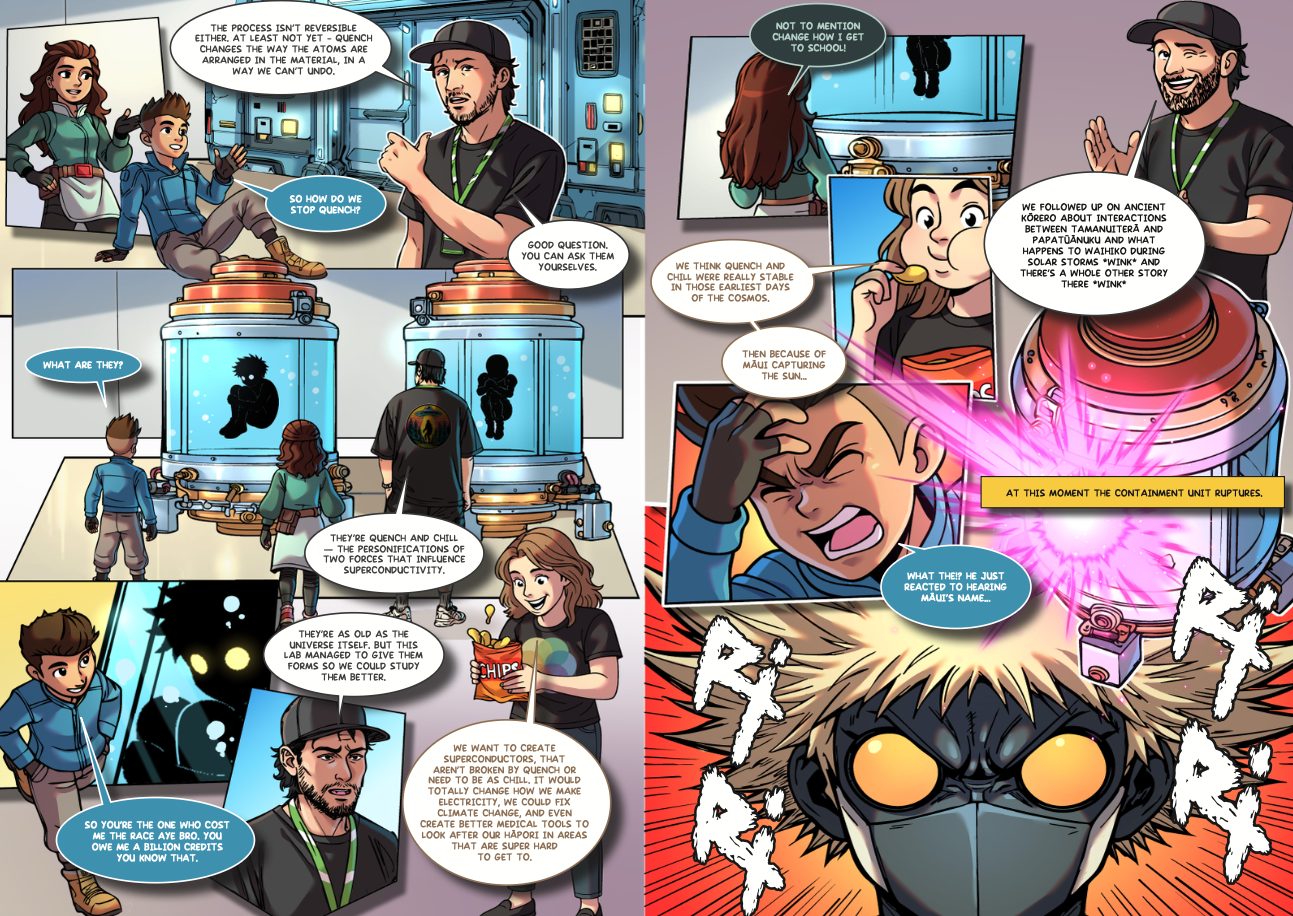
Wrath of Quench Pt I is a science communication graphic novel developed to translate the complex subjects of superconductivity, photonics, and quantum science into an accessible, engaging illustrated format. Created in collaboration with Te Whai Ao - Dodd-Walls Centre and Tūhura Otago Museum, the project was designed to support public education, outreach, and rangatahi engagement through story-led visual communication.
The work sits within a moment where quantum science has become a major public-engagement priority - the United Nations declared 2025 the International Year of Quantum Science and Technology to raise awareness of the field and its applications (UNESCO, n.d.), with Te Whai Ao part of the leadership ecosystem driving that engagement in Aotearoa.
The central challenge was communicating a field that is technically dense, abstract, and often inaccessible to non-specialist audiences. Quantum science and superconductivity involve ideas that are difficult to visualise and difficult to explain through plain-language communication alone, so the project needed to bridge specialist knowledge and general comprehension without losing credibility or depth. This made the graphic novel format strategically useful: research on comics in science education finds that the interplay of text, image, narrative, and memory cues can improve engagement, particularly among learners who respond less strongly to conventional science materials (Hosler & Boomer, 2011).
SOW Snapshot
- Core Deliverables: Completed graphic novel publication, print-ready PDF files, digital distribution version, cover artwork, and selected promotional visuals
- Scope: Concept ideation, story structure and scripting, integration of scientific reference material, character and environment design, science and technology visualisation, style exploration, page layout and panel composition, full illustration and colouring, lettering, cover design, iterative review checkpoints, and scientific accuracy checks
- Audience: Rangatahi and general public; museum and outreach audiences engaging with photonic and quantum science
- Format: Original science-focused graphic novel - print-ready and digital
- Timeframe: October 2025 · approximately 8 weeks
- Key Requirements: Scientific accuracy (research-informed and checked), narrative accessibility for non-specialists, museum and outreach suitability
- Service Connection: Comic Books, Science communication, Visual Design, Publishing, IP Creation and Story Development, Strategic Communication
Outcomes
Māui Studios approached the project as a narrative-led science translation - not simply illustrating facts, but building a storyworld capable of carrying difficult concepts in a more intuitive, visual, and emotionally engaging way. The approach combined narrative framing to make research themes easier to follow, character and environment design to give abstract science a visual context, and science visualisation to translate unseen processes into understandable imagery, with milestone reviews and scientific checks retaining technical credibility throughout, and print and digital delivery planned to support wider outreach.
This aligned closely with Te Whai Ao's community engagement model, which uses schools, museums, and public-facing formats to engage whānau and wider communities with photonic and quantum technologies (Te Whai Ao - Dodd-Walls Centre, n.d.-a).
The deliverable is a fully illustrated graphic novel publication operating as both a creative work and a public science communication asset - narrative development, visual worldbuilding, illustrated page production, cover design, print-ready files, digital outputs, and promotional assets. As an outcome, it creates a format through which complex research can be presented in a way better suited to museum engagement, outreach, public learning, and youth-facing interpretation than a standard technical document or research summary.
Impact Metrics
Because the project is delivered against the SOW, the strongest evidence base is externally defensible context and intended indicators rather than internal results not yet measured.
Intended Outcomes
- Translate superconductivity and quantum science into an engaging illustrated narrative
- Deliver a print-ready and digital publication for outreach and education use
- Create a format with stronger rangatahi and public-engagement potential than standard research communication
- Support Te Whai Ao and Tūhura's broader mission around quantum literacy and science outreach
Context
- 2025 was declared the International Year of Quantum Science and Technology by the United Nations, underscoring the public-engagement priority the project serves (UNESCO, n.d.)
- Te Whai Ao spans seven institutions and around 200 students and researchers, indicating the scale of the research ecosystem behind the project, and runs a community-engagement programme explicitly targeting schools, museums, and public audiences (Te Whai Ao - Dodd-Walls Centre, n.d.-a, n.d.-b)
- Tūhura Otago Museum recorded 94% overall visitor satisfaction in its 2023–2024 annual report (based on 867 respondents, ±2.7% at the 95% confidence interval), evidencing the reach and trust of the delivery partner's public platform (Tūhura Otago Museum, 2024)
Format Effectiveness
- Comic books have strong potential to convey concepts and motivate student engagement in science learning (Hosler & Boomer, 2011)
- A 2024 pilot study found science comics support engagement with complex scientific knowledge among secondary students (Faria, 2024)
Future Opportunities
- Museum exhibition integration drawing on the graphic novel's visual world
- Education resources for schools aligned to the publication
- Workshop and outreach support materials for public science programmes
- Animated or digital companion assets extending the narrative
- AR or interactive science-storytelling layers on the printed pages
- A repeatable research-to-storytelling model for translating other advanced science topics into illustrated IP
References
- Faria, C. (2024). Potentialities of science comics for science communication and education: A pilot study with secondary school students. Journal of Science Communication, 23(08). https://jcom.sissa.it/article/pubid/JCOM_2308_2024_N02/
- Hosler, J., & Boomer, K. B. (2011). Are comic books an effective way to engage nonmajors in learning and appreciating science? CBE-Life Sciences Education, 10(3), 309–317. https://pmc.ncbi.nlm.nih.gov/articles/PMC3164570/
- Te Whai Ao - Dodd-Walls Centre. (n.d.-a). Community engagement. https://www.doddwalls.ac.nz/our-work/community-engagement
- Te Whai Ao - Dodd-Walls Centre. (n.d.-b). Home. https://www.doddwalls.ac.nz/
- Tūhura Otago Museum. (2024). Annual report 2023–2024. https://otagomuseum.nz/assets/Uploads/Tuhura-Otago-Museum-Annual-Report-23-24-FINAL-29.11.24-small-updated.pdf
- UNESCO. (n.d.). International Year of Quantum Science and Technology. https://www.unesco.org/en/years/quantum-science-technology